
Why Understanding the Insurance Claim Process Matters for Georgia Accident Victims
The insurance claim process can feel overwhelming after an accident, but it doesn’t have to be. Here’s what you need to know right away:
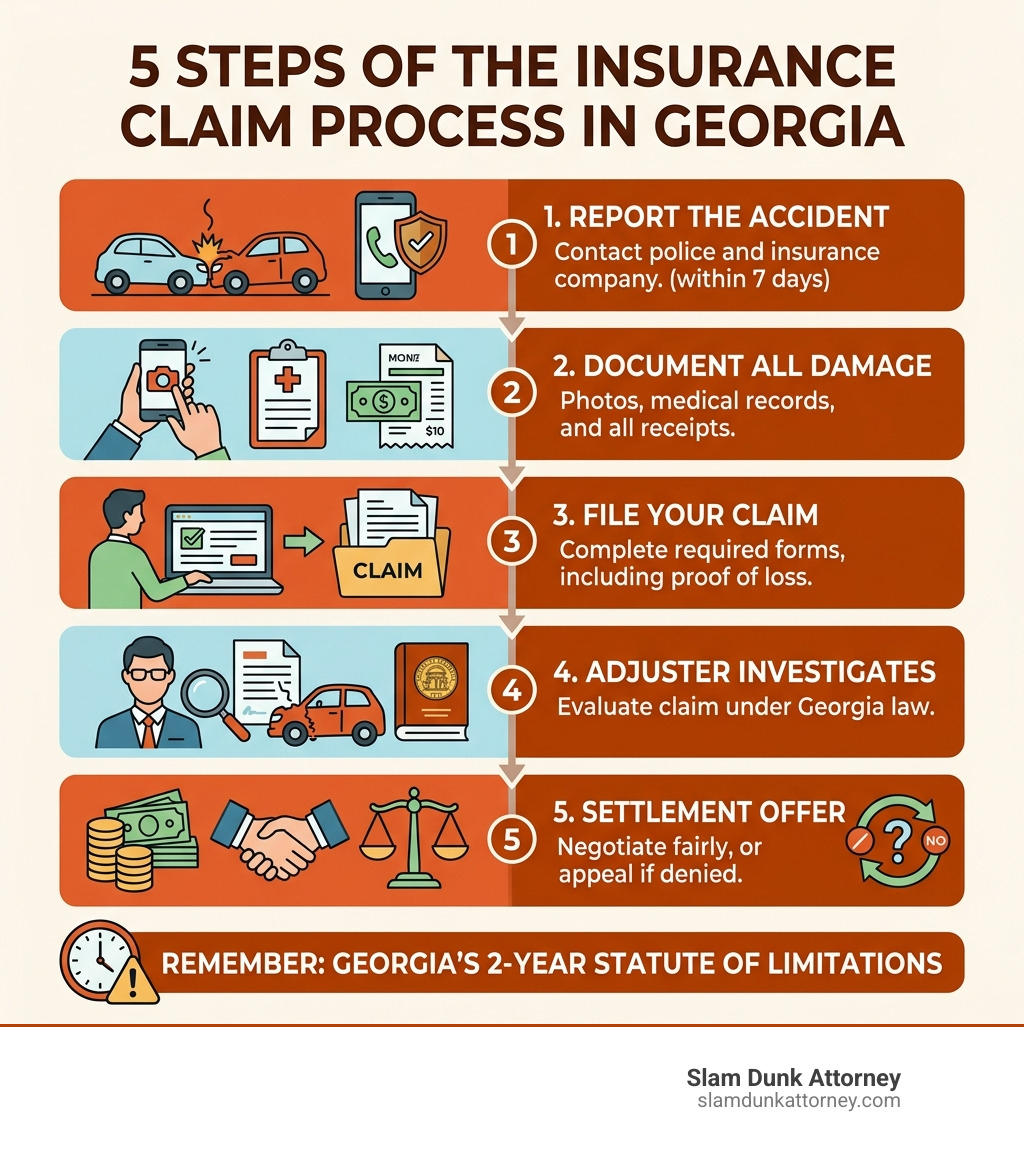
The 5 Core Steps of the Insurance Claim Process:
- Report the accident: Contact your insurance company within 7 days and file a police report in Georgia.
- Document everything: Take photos, gather witness information, and keep all medical records and receipts.
- File your claim: Submit required forms like proof of loss and provide supporting documentation.
- Investigation phase: An insurance adjuster reviews your claim and evaluates damages.
- Settlement or dispute: Accept a fair offer, negotiate for more, or appeal if denied.
In Georgia, we operate under an at-fault insurance system, which means the person responsible for the accident is liable for damages. Georgia also follows a modified comparative negligence rule with a 50% bar. If you’re found more than 50% at fault, you cannot recover compensation under Georgia law.
Most Georgia residents don’t realize they have just 2 years from the date of their accident to file a personal injury claim under Georgia law. Missing this deadline means losing your right to compensation entirely. You can find more information on state regulations through the Georgia Office of Commissioner of Insurance and Safety Fire.
Whether you’ve been in a car accident in Duluth, Georgia, suffered a slip and fall, or are dealing with property damage, understanding how the process works protects your rights and maximizes your recovery.
Peter Jaraysi, Esq. founded Slam Dunk Attorney in Duluth, Georgia to help people pursue full and fair compensation for injuries caused by negligence. Over the years, our team has helped countless Georgia residents steer the insurance claim process after accidents, pushing back against insurance companies that try to minimize payouts or deny valid claims. Our goal is simple: give you the knowledge and support you need to get what you deserve under Georgia law.
Proudly Serving Duluth and All of Georgia Contact us to start your recovery! Explore Our Practice Areas

Navigating the Insurance Claim Process in Georgia
When you are standing on the side of Peachtree Industrial Boulevard after a fender bender, legal theory is the last thing on your mind. You just want your car fixed and your neck to stop aching. However, understanding the framework of the insurance claim process in Georgia is the secret to not getting dunked on by big insurance companies.
In Georgia, we follow an at-fault insurance system. This is pretty straightforward: if you cause the accident, your insurance pays for the other person’s damages. If they cause it, their insurance pays for yours. It sounds simple, but determining who caused it is where things get spicy.
This brings us to Georgia’s modified comparative negligence rule, also known as the 50% bar rule. Under Georgia law, you can still recover money even if you were partially responsible for the accident as long as you were less than 50% at fault. For example, if a jury decides you were 10% at fault because you were slightly over the speed limit, but the other guy was 90% at fault for blowing a red light, you can still collect 90% of your total damages. But if you hit that 50% mark? In Georgia, that is a game over for your compensation.
The insurance claim process is essentially a formal request to an insurance company to pay for a loss covered by a policy. Whether it’s an auto accident, a slip and fall at a grocery store in Lawrenceville, or a tree falling on your house in Alpharetta, the process is the mechanism that moves money from the insurer’s bank account to yours.
More info about insurance claims services
Immediate Steps to Start Your Insurance Claim Process
The first 24 hours after an incident are the clutch moments. What you do right away sets the foundation for your entire claim.
- Prioritize Safety and Call 911: Even if it’s a minor accident in a Brookhaven parking lot, call the authorities. In Georgia, a police report is one of the most vital pieces of evidence. It provides an objective third-party account of the scene, the weather, and any citations issued.
- Document the Scene: Channel your inner professional photographer. Take photos of the vehicle damage, the road conditions, traffic signs, and any visible injuries. If you are at a business in Decatur and you slipped on a wet floor, take a picture of the floor and look for wet floor signs (or the lack thereof).
- Exchange Information: Get the basics: name, contact info, driver’s license number, and insurance policy details. But here is a pro tip: don’t apologize. In the insurance claim process, “I’m so sorry” can be twisted by an adjuster to mean “I admit I caused the whole thing.”
- Seek Medical Attention: Some injuries, like whiplash or internal bruising, are like that one friend who is always late, they don’t show up until hours or days later. Seeing a doctor in Duluth, Georgia immediately creates a medical record that links your injuries directly to the accident.
- Notify Your Insurer: You usually have a small window (often 1 to 7 days) to report the incident to your own insurance company. Just stick to the facts: where, when, and who.
How to File an Auto Accident Claim in Georgia
Essential Documentation for the Insurance Claim Process
If the insurance claim process were a court case, documentation would be your star witness. Insurance companies love paperwork, and they will use any missing “i” or uncrossed “t” as an excuse to delay your payment.
Here is your championship checklist for documentation:
- The Police Report: As mentioned, this is the gold standard for fault determination.
- Proof of Loss Form: This is a formal, often notarized statement you send to the insurer. It details the amount of money you are requesting and why. In Georgia property claims, you often have a strict deadline (sometimes 30 to 60 days) to submit this once the company requests it.
- Medical Records and Bills: Keep every single receipt. From the emergency room visit in Atlanta to the physical therapy sessions in Marietta. If you had to buy a neck brace or prescription meds, keep the receipts.
- Repair Estimates: Get at least two or three written bids from reputable body shops or contractors in your local Georgia community.
- Income Documentation: If your injury kept you away from work, you’ll need pay stubs or tax returns to prove your lost wages.
The statute of limitations in Georgia for personal injury is generally 2 years. For property damage, you usually have 4 years. However, your specific insurance policy might have much shorter notice requirements. If you wait 18 months to tell your insurance company about a fender bender, they might deny the claim simply because you didn’t follow the policy rules for timely reporting.
Understanding the Role of the Insurance Adjuster
Once you file, the insurance company will assign a claims adjuster. Think of the adjuster as the referee, except they are paid by the other team.
The adjuster’s job is to:
- Investigate the Claim: They will look at the police report, interview witnesses, and maybe even check your social media (yes, they really do that).
- Review the Policy: They check to see if the incident is actually covered. For example, if you were using your personal car for a ride-sharing app without a commercial endorsement, they might try to deny the claim.
- Evaluate Damages: They will look at the repair estimates and medical bills to decide what they think the claim is worth.
- Make an Offer: This is the part where they usually send a lowball offer. They are hoping you are stressed and will take the first check they wave in front of you.
In Georgia, adjusters use specific rules to determine fault. If they decide you are 20% at fault, they will automatically deduct 20% from your settlement offer. It is our job to make sure they aren’t unfairly pinning blame on you just to save their company a few bucks.
What to Do if Your Claim is Denied or Delayed
It happens more than you’d think. You pay your premiums for years, and the one time you need help, the insurance company sends a denial letter or goes completely silent.
In Georgia, insurance companies have a duty of good faith. If they deny a claim without a legitimate reason or fail to settle a claim when liability is clear, they might be committing insurance bad faith (specifically under O.C.G.A. § 33-4-6).
If your claim is stuck:
- Ask for the Reason in Writing: If they deny you, they must tell you why. Is it a lack of documentation? A policy exclusion?
- Check the Facts: Sometimes adjusters make mistakes. They might have the wrong date or a typo in the police report.
- Contact the Georgia Department of Insurance: You can file a complaint with the Commissioner’s office if you feel you are being treated unfairly.
- Call in the Pros: This is where we come in. Sometimes, an insurance company won’t take you seriously until they see a law firm’s letterhead.
Replacement Cost vs. Actual Cash Value in Georgia Claims
When it comes to property damage, like your car or your home in Dunwoody, how the insurance company calculates value makes a huge difference in your bank account.
- Actual Cash Value (ACV): This is the garage sale price. It’s what your item is worth today, accounting for wear and tear (depreciation). If your 10-year-old car is totaled, ACV gives you enough money to buy another 10-year-old car, not a brand-new one.
- Replacement Cost: This is the retail price. It pays for what it costs to buy a brand-new version of the item today.
Most auto policies in Georgia pay ACV. Homeowners policies can vary. If you are displaced from your home due to a fire or storm, you should also ask about Additional Living Expenses (ALE). This covers the extra costs of living, like a hotel in Gwinnett County or extra gas for a longer commute, while your home is being repaired.
How a Duluth, Georgia Personal Injury Lawyer Can Help
You wouldn’t walk onto a basketball court against a professional team without a coach and a strategy. The insurance claim process is no different. Insurance companies have teams of lawyers and adjusters whose entire job is to pay you as little as possible.
At Slam Dunk Attorney, we take a championship-level team approach. We don’t just handle cases; we hustle for them.
How we support you:
- Investigation: We gather the evidence the adjuster missed, like nearby doorbell camera footage or independent witness statements.
- Negotiation: We know the lowball tactics. We come to the table with the facts and the law to demand full compensation.
- Litigation: If the insurance company refuses to be fair, we aren’t afraid to take them to court. We handle the findy phase, where we force them to turn over their internal notes, and represent you in front of a Georgia judge or jury.
- Direct Communication: You won’t be passed off to a robot. We believe in honesty and transparency.
Whether you are in East Point, Johns Creek, or right here in Duluth, Georgia, we are your local neighbors who know the local courts and the local tricks insurance companies play.
Conclusion
The insurance claim process doesn’t have to be a losing game. By taking immediate action, documenting every detail, and understanding your rights under Georgia’s at-fault system, you can protect your future.
Remember:
- Report the accident quickly.
- Don’t admit fault at the scene.
- Keep your receipts and medical records.
- Watch out for the 2-year statute of limitations.
If you’re feeling overwhelmed or the insurance company is giving you the runaround, you don’t have to do this alone. At Slam Dunk Attorney, we’re here to help Georgia residents in Duluth, Georgia, Atlanta, and across the state get back on their feet with the compensation they deserve. We bring the hustle, the honesty, and the transparency you need during a tough time.
The information provided on this blog is for general informational purposes only and is not intended to be, nor should it be construed as, legal advice. Every personal injury case is unique, and the laws and circumstances that apply can vary based on the specific facts of your situation. Reading this content does not create an attorney-client relationship. To receive legal advice specific to your case, you should consult directly with a qualified personal injury attorney licensed to practice in the state of Georgia.
Call or text 404-951-3513 or complete a Free Case Evaluation form