
When Loss Demands Answers: Your Guide to Georgia Wrongful Death Law
Wrongful death law in Georgia allows surviving family members to seek compensation when a loved one dies due to another’s negligence, recklessness, or intentional act. If you believe someone else is responsible for your loss, understanding your rights is the first step.
Key Points About Georgia Wrongful Death Claims:
- What it is: A civil lawsuit seeking financial compensation for the survivors’ losses and the deceased’s suffering before death.
- Who can file: Georgia law prioritizes the surviving spouse, then children, then parents, or the estate’s personal representative.
- Time limit: You generally have two years from the date of death to file a claim (O.C.G.A. § 9-3-33).
- What you can recover: The “full value of the life” (financial support and companionship), plus medical bills, funeral costs, and the deceased’s pain and suffering.
- Standard of proof: “Preponderance of the evidence” (more likely than not), a lower standard than in criminal cases.
Georgia’s wrongful death law provides a path forward. While no amount of money can replace a loved one, it ensures families don’t bear the financial burden of another’s negligence. I’m Peter Jaraysi, Esq., and my practice is dedicated to fighting for families navigating these complex cases. I understand the legal intricacies and the profound weight of your loss.
Proudly Serving Duluth and All of Georgia Contact us to start your recovery! Explore Our Practice Areas

Navigating Georgia’s Wrongful Death Law
When a loved one’s death is caused by someone else’s carelessness, Georgia’s wrongful death law provides a way for families to seek justice and financial stability. This isn’t about putting a price on a life, but about holding negligent parties accountable for the support and companionship your family has lost. Navigating this process while grieving is difficult, but we are here to clarify your rights and options under Georgia law.
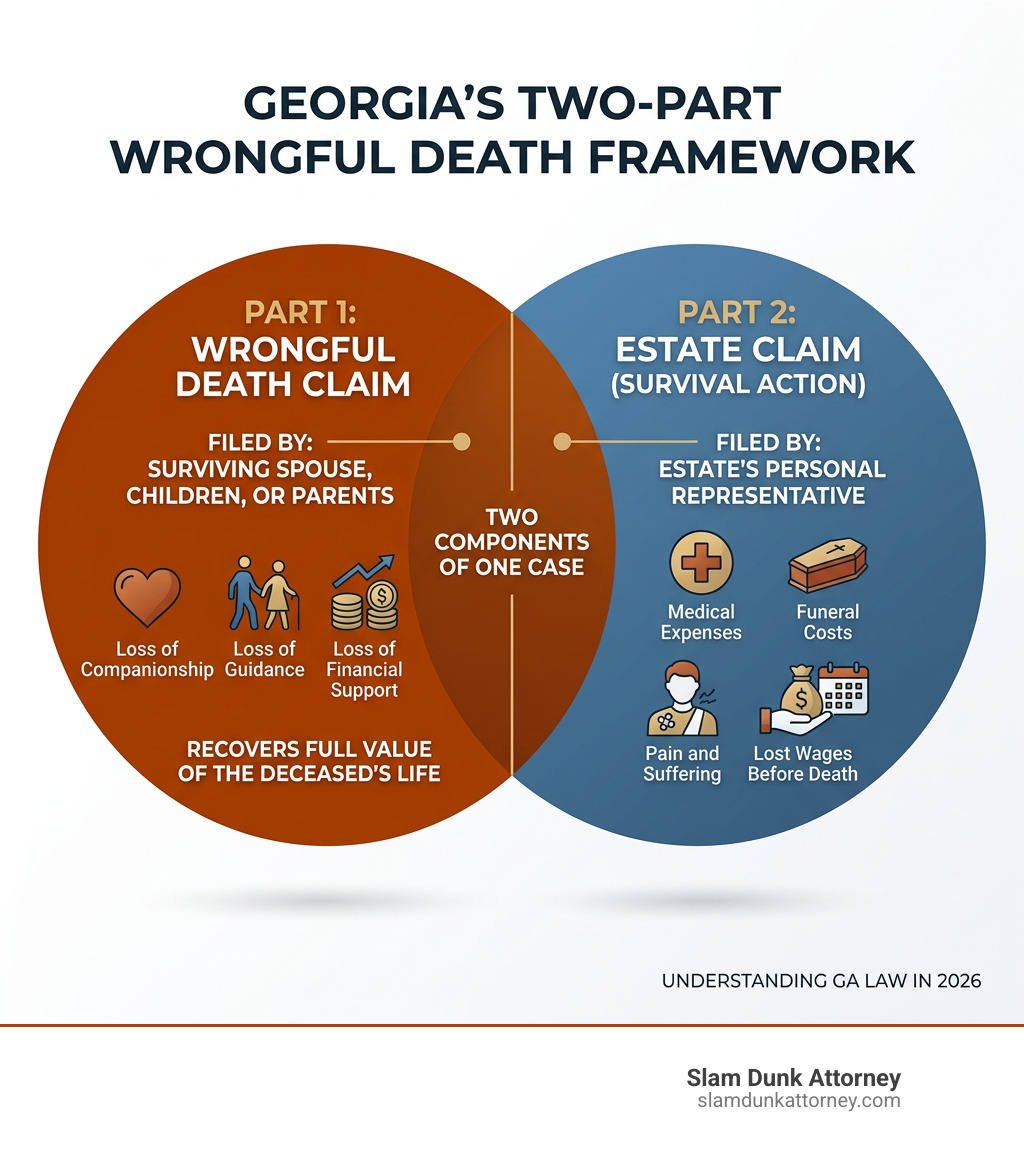
A crucial distinction in Georgia is that a wrongful death case involves two separate claims:
| Feature | Wrongful Death Claim (for Survivors) | Survival Action / Estate Claim (for the Estate) |
|---|---|---|
| Purpose | Compensates surviving family for their losses | Compensates the estate for losses the deceased suffered before death |
| Who Files | Surviving spouse, children, or parents (in order of priority) | The personal representative of the deceased’s estate |
| Damages Sought | “Full value of the life” (e.g., lost income, companionship, guidance) | Medical bills, funeral costs, pain and suffering of the deceased, lost wages before death |
This two-part structure dictates who can file and what compensation can be sought.
What Constitutes a Wrongful Death in Georgia?
A wrongful death claim is a civil action against a person or entity whose negligence or intentional act caused a death. It is separate from any criminal case. A defendant can be found liable in a civil suit even if acquitted in a criminal trial, as the burden of proof is lower.
To prove a wrongful death claim in Georgia, we must establish four elements:
- Duty of Care: The defendant had a legal obligation to act with reasonable care to prevent harming the deceased (e.g., a driver’s duty to follow traffic laws).
- Breach of Duty: The defendant failed to meet that duty through negligence, recklessness, or an intentional act.
- Causation: The defendant’s breach directly caused your loved one’s death.
- Damages: The death resulted in measurable financial and emotional harm to the surviving family.
The burden of proof is a “preponderance of the evidence,” meaning we must show it’s more likely than not (over 50% probability) that the defendant’s actions caused the death. This is less strict than the “beyond a reasonable doubt” standard in criminal cases.
Who Can File a Wrongful Death Lawsuit in Georgia?
Georgia law specifies who has the legal right (“standing”) to file a wrongful death lawsuit in a strict order of priority:
- The Surviving Spouse: The spouse is first in line. If there are children, the spouse and children share the recovery, with the spouse receiving at least one-third.
- The Children of the Deceased: If there is no surviving spouse, the deceased’s biological or legally adopted children can file.
- The Surviving Parent(s): If there is no spouse or child, the parents may file.
- The Personal Representative of the Estate: If no spouse, child, or parent survives, the estate’s representative can file the claim on behalf of the next of kin.
Understanding this hierarchy is crucial. Our team can clarify your eligibility under Georgia law. For more details, see our FAQs on Who Can File a Wrongful Death Lawsuit in Georgia? and our blog on Parties Who Can Sue Under Georgia’s Wrongful Death Law.
The Timeline for Filing: Georgia’s Statute of Limitations
It is critical to be aware of the strict legal deadline, or statute of limitations, for filing a wrongful death law claim in Georgia.
Generally, a lawsuit must be filed within two years from the date of death (O.C.G.A. § 9-3-33). If you miss this deadline, you will likely lose your right to seek compensation forever. While there are some exceptions, such as the timeline being paused (“tolled”) during a related criminal case, these are rare. Claims against government entities often have even shorter deadlines. Acting quickly is essential to preserve your legal rights. For more information, see our FAQ on What is the Statute of Limitations for a Wrongful Death Claim?.
Understanding Compensation: Damages in a Georgia Wrongful Death Case
While no money can replace a loved one, Georgia’s wrongful death law aims to provide financial relief. Damages are divided between the survivors’ claim for the “full value of the life” and the estate’s claim for pre-death losses.

The “full value of the life” includes two components:
- Tangible Value (Economic Damages): This covers the deceased’s lost financial contributions, such as future wages, benefits, and the value of services like childcare or household maintenance.
- Intangible Value (Non-Economic Damages): This compensates for the loss of companionship, guidance, love, and affection.
The estate can also pursue a survival action to recover the deceased’s medical expenses, lost wages before death, and conscious pain and suffering.
Punitive damages may be awarded in cases of extreme misconduct to punish the defendant and deter future wrongdoing. This requires clear and convincing evidence of willful misconduct, malice, or a conscious indifference to consequences. For more on these topics, see our FAQs on How Are Damages Calculated in a Wrongful Death Case? and How Are Wrongful Death Settlements Distributed?.
Common Defenses and the Role of State Law in Wrongful Death Law
The at-fault party’s insurance company will likely raise defenses to reduce or deny your claim. Common defenses include:
- Comparative Negligence (Georgia’s 50% Bar Rule): Under O.C.G.A. § 51-12-33, if the deceased was partially at fault, your compensation is reduced by their percentage of fault. If they are found 50% or more at fault, you cannot recover any damages.
- Assumption of Risk: Arguing the deceased knowingly accepted the risks of a dangerous activity.
- Statute of Limitations: Claiming the lawsuit was filed after the two-year deadline.
- Lack of Causation: Denying their client’s actions caused the death.
The Indispensable Role of State Statutes:
Every aspect of a wrongful death claim—from who can file to the damages available—is governed by Georgia state statutes. An attorney with deep knowledge of Georgia-specific laws is essential, as laws from other states do not apply. Our FAQ on Who Can Be Sued in a Wrongful Death Case? provides more context on liable parties under Georgia law.
How a Duluth Wrongful Death Lawyer Can Help
Facing the loss of a loved one due to negligence is unimaginable, and you shouldn’t have to steer a complex legal battle alone. An experienced wrongful death law attorney in Duluth, Georgia, is an invaluable ally. At Slam Dunk Attorney, we provide both expert legal guidance and compassionate support during this difficult time.
Here’s how our championship-level team can help:
- Legal Guidance and Expertise: We provide clear explanations of your rights under Georgia’s intricate wrongful death law, including who can file and how the “full value of life” is calculated.
- Thorough Evidence Gathering: Our team carefully investigates and gathers critical evidence, including police reports, medical records, and expert testimony, to build a strong case.
- Navigating Complexities: We handle all legal problems, from dealing with insurance companies to countering common defenses like comparative negligence, to maximize your compensation.
- Fighting for Your Family: We are dedicated advocates who aggressively negotiate for a fair settlement and are always prepared to take your case to trial if necessary.
- Direct Communication and Transparency: We pride ourselves on honesty and keeping you informed. Our comprehensive care allows you to focus on healing while we handle the legal work.
We serve families across Duluth, Atlanta, Norcross, Brookhaven, Decatur, Johns Creek, Kennesaw, Lawrenceville, Alpharetta, Chamblee, Dunwoody, East Point, and Marietta, Georgia. If you’ve lost a loved one and believe someone else is responsible, we invite you to reach out for a free, no-obligation consultation. Understanding your rights is the first step toward securing your family’s future. Let us fight for the justice you deserve.
For more information on how we can assist you, visit our dedicated page for a Wrongful Death Lawyer Duluth.
The information provided on this blog is for general informational purposes only and is not intended to be, nor should it be construed as, legal advice. Every personal injury case is unique, and the laws and circumstances that apply can vary based on the specific facts of your situation. Reading this content does not create an attorney-client relationship. To receive legal advice specific to your case, you should consult directly with a qualified personal injury attorney licensed to practice in the state of Georgia.
Call or text 404-951-3513 or complete a Free Case Evaluation form