
Negligent Security | Georgia
Evidence Preservation in Negligent Security Cases
Critical steps to protect your claim when a property owner fails to maintain adequate security.
By Peter F. Jaraysi · Published September 16, 2026
Preserving Evidence in Negligent Security Cases: Why Time Is Critical
Security footage is routinely overwritten or deleted within 30 to 90 days—and once it’s gone, it cannot be recovered. If you’ve been harmed in an assault, robbery, or attack at a property with inadequate security, the evidence that proves what happened is disappearing right now. Understanding what evidence matters and acting immediately can mean the difference between a strong case and one with critical gaps.
Not sure what your next step is?
Talk it through with our team — the first consultation is free, confidential, and carries no obligation.

Why Evidence Disappears in Negligent Security Cases
Security camera footage vanishes automatically on most commercial and residential systems because they operate on a rolling, continuous-overwrite cycle. Unlike a file you save on your computer, surveillance systems don’t store footage indefinitely. Instead, they record over old footage to make room for new recordings. Once overwritten, that footage is gone forever—no recovery service can retrieve it.
The timeline is unforgiving. A typical retail store or apartment complex may retain footage for only 7 to 30 days; larger properties or those with more robust systems might keep 60 to 90 days. But many properties don’t maintain their systems well, and equipment failures can shorten retention even further. Witnesses also disappear: people move away, memories fade within days, and contact information becomes impossible to track down if you wait too long.
Physical evidence at the scene gets cleaned up. Debris, broken glass, weapons, and other items vanish during property restoration. Records held by the property owner—maintenance logs, prior incident reports, security contracts—may be destroyed or hidden unless you take legal steps to preserve them. Property owners have no incentive to keep evidence that shows they failed to provide adequate security.
Security Footage and Video Evidence
Most commercial properties use security systems that record continuously but retain footage only for a set period, typically 7 to 90 days depending on system capacity and settings. Once that window closes, the system automatically deletes the oldest footage to make room for new recordings. A single preservation request made weeks after an incident is almost always too late.
Multiple camera angles often exist at the scene: exterior shots of parking lots and building entrances, interior hallway footage, and close-ups of specific areas. Each angle may be stored separately, and each may have a different retention schedule. The timestamp and metadata embedded in the footage—the date, time, and technical details of the recording—are just as important as the video itself. They prove when the incident occurred and establish the chain of evidence.
A preservation request must be made immediately. The moment you or a lawyer contacts the property owner or security company and formally requests that footage be preserved, a legal duty to retain that evidence begins. Without that request, the system continues its automatic deletion cycle, and critical video is lost.
Witness Statements and Contact Information
Eyewitnesses are often the most compelling evidence in a negligent security case. But their value evaporates quickly. Memory is unreliable after just a few days; witnesses remember details differently as time passes, and their accounts become less credible if they’re recorded months after the fact.
Collect witness names, phone numbers, and email addresses while the incident is still fresh—ideally within hours. Ask them to write down what they saw, or take a brief written statement on the spot if possible. Written statements made close to the time of the incident carry far more weight than verbal recollections months later. Witnesses also relocate: they change jobs, move to different cities, or become impossible to locate if you wait too long.
If a witness is no longer available when your case moves forward, their early statement—if documented—can still be used. But if you never collected their contact information or a statement, that testimony is lost forever.
Physical Evidence at the Scene
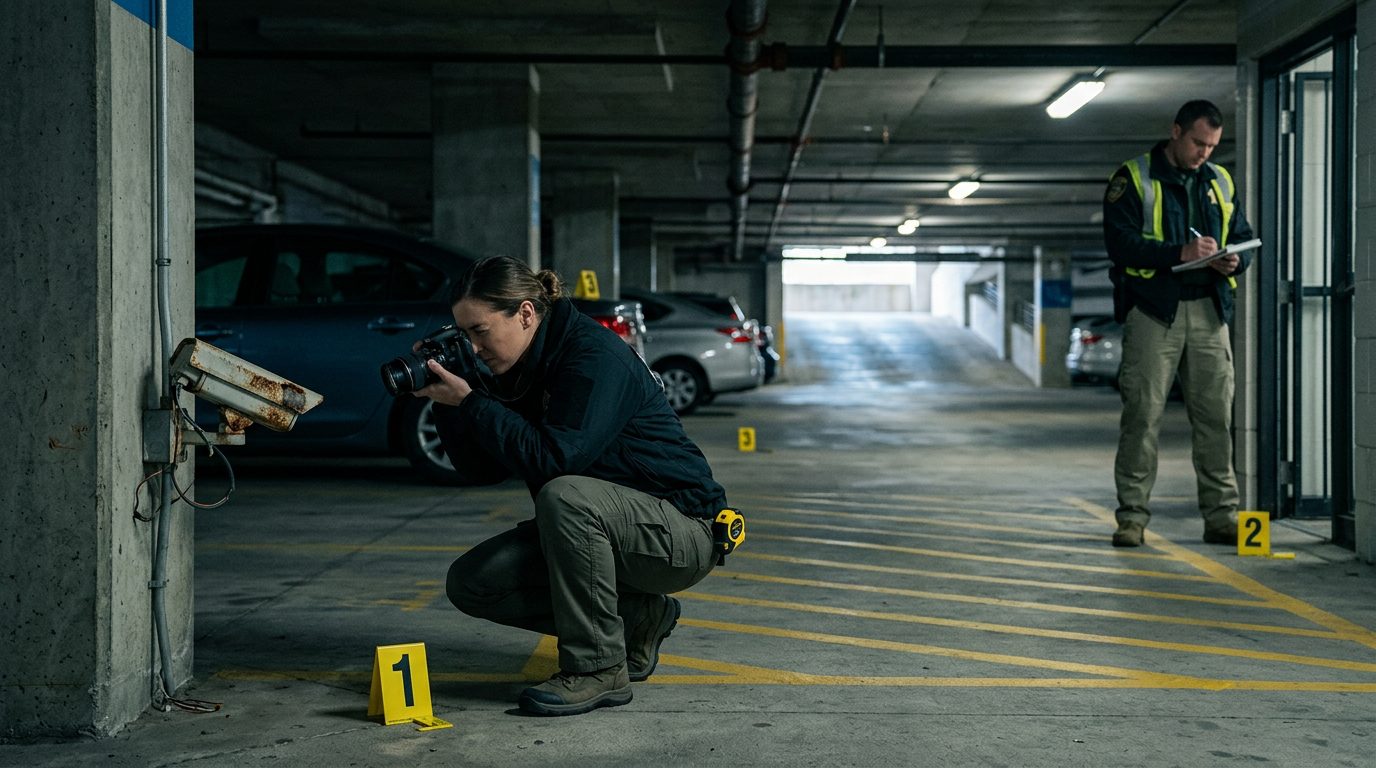
Photograph and video the scene immediately. Capture lighting conditions, sight lines, obstacles, and any visible security measures (or the absence of them). These details establish whether the property owner should have foreseen the risk of harm and what security measures were—or were not—in place.
Physical items at the scene—weapons, debris, broken glass, or other objects—may be removed during cleanup or property restoration. Once they’re gone, they can’t be examined by an expert or presented as evidence. Scene documentation must happen before the property is altered.
Photographs of your injuries taken right away are also critical. Medical staff often take photos in the emergency room; request copies and keep them. These contemporaneous images are powerful evidence of the harm you suffered and are harder to challenge than your recollection months later.
Property Records and Security Documentation
The property owner and security company hold records that can prove negligent security: maintenance logs, incident reports, security policies, alarm system records, and access logs. These documents may reveal a pattern of inadequate security or prior incidents at the property—evidence that strengthens your claim significantly.
Property owners are often reluctant to produce unfavorable records voluntarily. A formal preservation letter—a legal notice demanding that evidence be retained—creates an enforceable duty and overcomes that resistance. Without it, records may be destroyed, lost, or “accidentally” discarded.
Not sure what your next step is?
Talk it through with our team — the first consultation is free, confidential, and carries no obligation.
Medical and Police Records
A police report filed at the time of the incident creates an official, contemporaneous record. It documents what happened, who was involved, and what injuries were sustained. If you haven’t filed a report, do so as soon as possible.
Medical records from the emergency room, urgent care, or hospital establish the nature and severity of your injuries. Photographs taken by medical staff, X-rays, and clinical notes are all valuable documentation. Delays in seeking medical attention create gaps in the record and can weaken your claim. Seek care immediately and keep every receipt, report, and record.
The Role of a Preservation Letter
A preservation letter is a formal legal notice sent to the property owner, security company, and any other party who may hold evidence. It demands that all evidence related to the incident be retained and not destroyed. Once received, the recipient has a legal duty to preserve that evidence.
Without a preservation letter, evidence may be destroyed inadvertently during routine maintenance or intentionally to avoid liability. With one, destruction becomes a serious problem: a court can impose sanctions, draw an “adverse inference” (assume the destroyed evidence would have helped your case), or even dismiss the property owner’s defenses.
A lawyer can send a preservation letter immediately after an incident—often within hours—to prevent irreversible loss of evidence.
What You Should Do Right Now
Document everything. Take photographs and video of the scene, your injuries, and any visible security measures (or the lack thereof). Write down the date, time, and location.
Collect witness information. Get names, phone numbers, email addresses, and brief statements from anyone who saw what happened. Do this while they’re still present or memories are fresh.
File a police report. Contact local law enforcement if you haven’t already. Request a copy of the report once it’s filed.
Seek medical attention. Get evaluated and treated immediately. Keep all medical records, receipts, and photographs.
Do not alter the scene. Don’t clean up, move items, or change anything at the location where the incident occurred.
Contact a lawyer as soon as possible. Evidence preservation is time-sensitive and irreversible. Delays can result in permanent loss of critical proof.
How a Negligent Security Lawyer Helps Preserve Evidence
An attorney can immediately issue a preservation letter to the property owner, security company, and any other party holding evidence. This creates a legal duty to retain footage, records, and physical evidence before it’s lost.
A lawyer identifies what evidence exists and where it’s located. They understand how security systems work, typical retention policies, and what records a property owner is required to keep. Legal counsel can file a lawsuit or take other steps to compel production of evidence before the window closes.
Early legal involvement often prevents evidence destruction and significantly strengthens your case. The sooner you act, the more evidence you’ll have to prove what happened.

Frequently Asked Questions
How long does security camera footage typically last before it’s deleted?
Most systems retain footage for 7 to 90 days, depending on system capacity and settings; once overwritten, it cannot be recovered.
What is a preservation letter and why does it matter?
A preservation letter is a formal legal notice that creates a duty on the property owner to retain all evidence; without it, critical footage and records may be destroyed.
Can I recover security footage that has already been overwritten?
No. Once a security system overwrites footage on its rolling cycle, the data is permanently deleted and cannot be recovered.
What evidence should I collect immediately after a negligent security incident?
Photographs of the scene and your injuries, witness names and contact information, a police report, and all medical records—collected within hours or days, not weeks.
Why is it important to contact a lawyer immediately?
Evidence disappears on a strict timeline. A lawyer can send a preservation letter, identify what evidence exists, and take steps to prevent permanent loss before it’s too late.
If you or a family member were harmed during an assault, robbery, or attack at a property with inadequate security, evidence preservation can’t wait. Contact Slam Dunk Attorney for a free case review to discuss what happened and what evidence you still have time to protect. People in your situation can reach out, and we’re here to help.
For more information about negligent security claims in Georgia, visit our negligent security page.
Act quickly—evidence disappears fast
Security camera footage is typically retained for 7 to 90 days before it's overwritten and lost forever. Once deleted, it cannot be recovered. If you've been injured due to inadequate security, preserving video, incident reports, and witness statements immediately is essential to your claim.
Key evidence to preserve in negligent security claims
Security camera footage
Video from the time of the incident and surrounding hours. Request it in writing immediately—most systems overwrite after 7–90 days depending on capacity and settings.
Incident reports and logs
Written records filed by the property owner or manager, including details of what happened, who responded, and any prior security concerns at the location.
Witness statements and contact information
Names, phone numbers, and written accounts from anyone who saw the incident or can testify to the property's security conditions.
Maintenance and security records
Documentation showing whether locks, lighting, alarms, or security personnel were in place, inspected, or neglected before your injury.
Why preservation matters in your case
A preservation letter creates a legal duty
A formal written notice to the property owner establishes their obligation to retain all evidence. Failure to preserve evidence can result in sanctions against them and strengthens your claim.
Video evidence is often decisive
Security footage can show exactly what happened, whether adequate lighting and security measures were in place, and whether the property owner's negligence contributed to your injury.
Timing is everything
Waiting weeks or months to request evidence means it may already be deleted. Immediate action preserves your strongest proof before it's gone.
Documentation supports your narrative
Incident reports, maintenance logs, and prior complaints establish a pattern of negligence and show the owner knew or should have known about security risks.
Steps to take right now
Document everything yourself
Take photos and videos of the scene, lighting, locks, cameras, and any visible security gaps. Write down what you remember while it's fresh, and note the date and time.
Collect witness information
Get the names and contact details of anyone who saw what happened or can describe the property's security conditions. Ask them to write down what they saw.
Request evidence in writing
Send a formal letter to the property owner or manager requesting all security footage, incident reports, maintenance records, and any prior complaints. Keep a copy for your file.
Consult with an attorney immediately
An attorney can send a preservation letter on your behalf, ensuring the property owner understands their legal obligation to retain evidence and protecting your right to recover.
Don't let evidence disappear
Negligent security claims depend on proof that the property owner failed to maintain adequate security and that this failure directly caused your injury. Without preserved evidence, proving negligence becomes much harder. The sooner you act, the stronger your case.