
Why Burn Injuries Open the Door to Legal Action in Georgia
If you’re wondering whether you can sue for burn injury, the answer depends on how you were hurt and who was responsible. In Georgia, you have the right to pursue compensation when someone else’s negligence causes your burn injury—whether from a car accident, defective product, workplace hazard, or unsafe property condition.
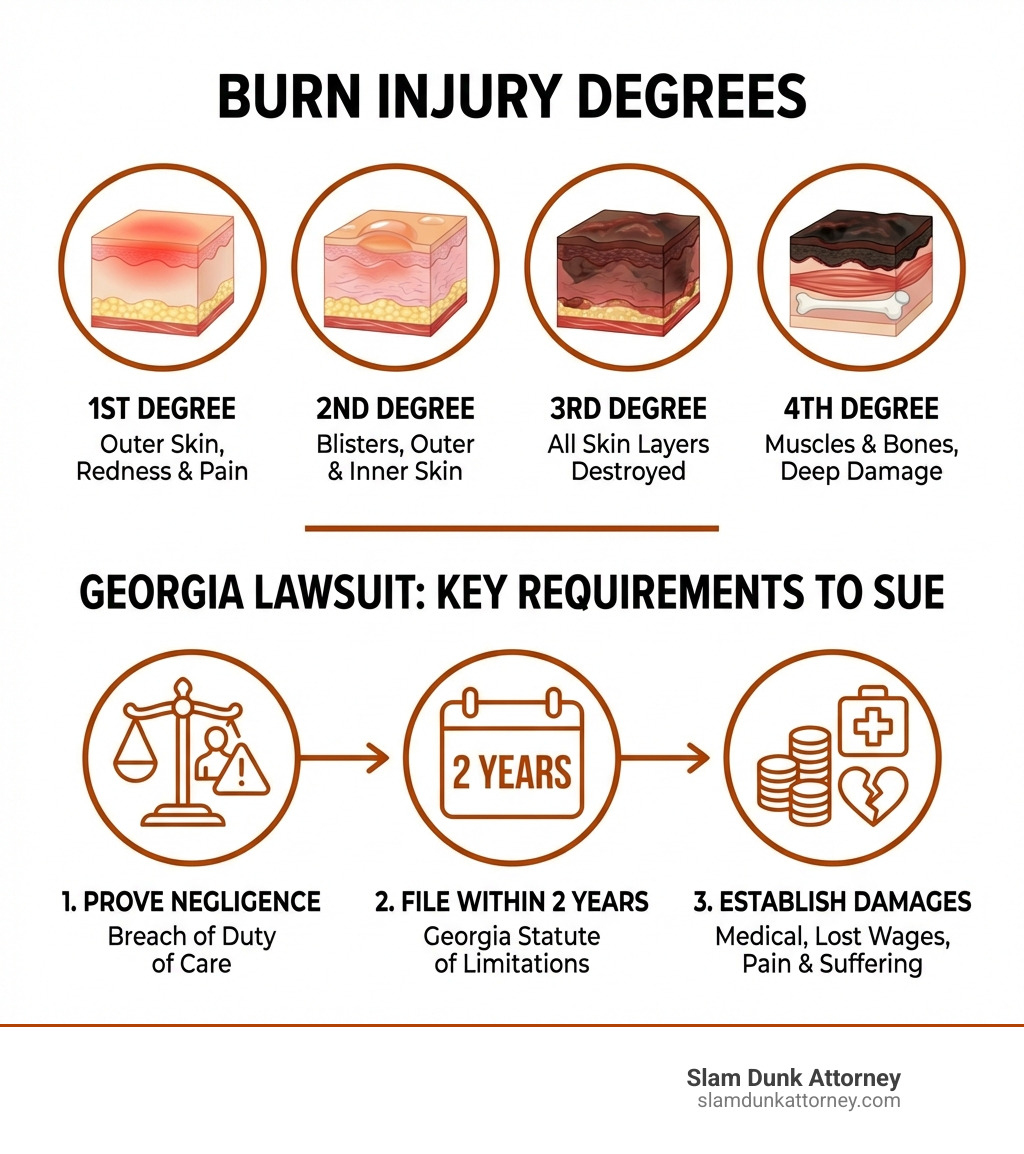
You can sue for burn injury in Georgia if:
- Someone owed you a duty of care (like a property owner, employer, or product manufacturer)
- They breached that duty through negligence or recklessness
- Their breach directly caused your burn injury
- You suffered damages (medical bills, lost wages, pain and suffering)
- You file within Georgia’s two-year statute of limitations
Burn injuries affect hundreds of thousands of people every year across the United States. These injuries range from minor first-degree burns that redden the skin to devastating fourth-degree burns that damage muscles, tendons, and bones. According to recent data, the average burn settlement reached $63,119 in 2021-2022, with medical benefits averaging $44,099 and indemnity benefits $19,020.
Most burn injuries happen at home, according to the Centers for Disease Control and Prevention. Household fires account for the majority of burns seen in emergency rooms across the country. But burns also occur in workplaces, car accidents, and from defective products—and when these injuries result from someone else’s negligence, Georgia law provides a path to justice.
The severity of your burn matters legally. First-degree burns affect only the outer skin layer, causing redness and pain. Second-degree burns penetrate deeper, creating blisters and intense discomfort. Third-degree burns destroy all skin layers and often require skin grafts. Fourth-degree burns extend to muscles and bones, frequently resulting in permanent disability or disfigurement.
Georgia operates under a modified comparative negligence system with a 50% bar rule. This means you can recover damages only if you’re less than 50% responsible for the accident that caused your burn injury. If you share some fault, your compensation decreases proportionally—but you can still pursue a claim.
When can you sue? Common scenarios include landlords who fail to maintain smoke alarms, employers who ignore safety protocols, manufacturers who sell defective products, and drivers whose negligence causes vehicle fires. Each situation requires proving that negligence directly caused your injury.
Soy Peter Jaraysi, abogado., and I’ve built my practice in Duluth, Georgia around one mission: holding negligent parties accountable when they cause serious injuries like burns. Through years of handling sue for burn injury cases, I’ve seen how these injuries devastate lives—and how the right legal approach can secure the compensation victims need to rebuild.
Orgullosos de servir a Duluth y a todo Georgia ¡Contáctenos para comenzar su recuperación! Explore nuestras áreas de práctica
When Can You Sue for Burn Injury Under Georgia Law?
In Georgia, the legal landscape for burn injuries is built on the foundation of personal injury law. We often see clients who are unsure if their situation “qualifies” as a lawsuit. The truth is, if your injury was preventable and caused by another party’s failure to act reasonably, you likely have grounds to sue for burn injury.
Proving Negligence to Sue for Burn Injury
To win a burn injury case in Georgia, we must establish four key elements of negligence. Think of these as the four legs of a table; if one is missing, the case won’t stand.
- Deber de diligencia: We must show the defendant had a legal obligation to keep you safe. For example, a restaurant in Atlanta has a deber de diligencia to serve coffee at a temperature that won’t cause instant third-degree burns.
- Incumplimiento del deber: We prove the defendant failed to meet that duty. This could be a landlord in Norcross neglecting faulty wiring or a manufacturer in Decatur releasing a space heater that spontaneously combusts.
- Causalidad: We must link the breach directly to your injury. It’s not enough that a product was defective; we must prove that the defect is what caused your specific burn.
- Daños: Finally, we document the real-world losses you’ve suffered—medical bills, lost income, and the physical pain of the degrees of burn injuries.
Georgia’s 50% Bar Rule: It’s important to understand our state’s modified comparative negligence rule. If a jury finds you were 20% at fault (perhaps you ignored a warning sign), your total compensation is reduced by 20%. However, if you are found to be 50% or more responsible, Georgia law bars you from recovering any compensation at all. This is why having a skilled Burn Injury Lawyer is vital to ensure fault is attributed correctly.
Common Causes That Lead to a Lawsuit
Burn injuries aren’t just caused by open flames. Our team sees a wide variety of negligent acts that result in life-altering injuries:
- Scalds: Hot liquids are a leading cause of burns, especially in children and the elderly. Whether it’s a scald from a burst pipe in a poorly maintained apartment or a spill in a commercial kitchen, these are often preventable.
- Chemical Burns: Exposure to corrosive substances in industrial settings or even through defective household cleaners can lead to internal and external tissue damage.
- Apartment Fires: Landlords have a strict responsibility to provide working smoke detectors and clear fire escapes. Failure to do so is a classic example of premises liability.
- Defective Products: From exploding e-cigarettes to lithium-ion batteries in cell phones that overheat, product manufacturers are held to “strict liability” standards in Georgia if their product is inherently dangerous.
- Workplace Accidents: Industrial accidents are the second leading cause of fires in the U.S. While workers’ comp usually covers these, a third-party lawsuit might be possible if a machine manufacturer was at fault.
- Electrical Hazards: Faulty wiring in a Brookhaven office building or exposed live wires on a construction site can cause deep tissue burns and cardiac issues.
For more detailed insights, check out our guide on La cruda realidad sobre las reclamaciones por lesiones por quemaduras.
Georgia’s Statute of Limitations to Sue for Burn Injury
Time is not on your side after an accident. Under Georgia Code Section 9-3-33, the statute of limitations for personal injury claims—including burn injuries—is generally dos años a partir de la fecha del incidente.
If you miss this deadline, the Georgia courts will almost certainly dismiss your case, regardless of how severe your injuries are. This two-year window is why we emphasize immediate action. We need time to:
- Preserve physical evidence (like the defective appliance or the charred remains of a vehicle).
- Gather witness statements while memories are still fresh.
- Compile comprehensive medical records to prove the extent of the damage.
Calculating Compensation and Seeking Justice in Duluth, Georgia
When we talk about what a case is worth, we are looking at how the injury has changed your life—financially, physically, and emotionally.
Types of Damages Available to Victims
In Georgia, “damages” are split into two main categories: economic and non-economic.
Economic Damages (The “Receipts”): These are the objective financial losses you’ve incurred. They include:
- Facturas médicas: Hospital stays, surgeries, skin grafts, and long-term physical therapy.
- Salarios perdidos: Money you lost while unable to work, as well as “loss of earning capacity” if you can no longer perform your previous job.
- Future Care Costs: Severe burns often require years of follow-up procedures.
Non-Economic Damages (The “Impact”): These are more subjective but often represent the heaviest burden.
- Dolor y sufrimiento: Compensation for the physical agony of the burn and the grueling recovery process. You can learn more about how Georgia courts view dolor y sufrimiento through established legal standards.
- Desfiguración: Burns often leave permanent scars or keloids. This can lead to profound pérdida de consorcio (damage to your relationship with a spouse) and a loss of enjoyment of life.
- Angustia emocional: PTSD, anxiety, and depression are common after a traumatic fire or explosion.
Daños punitivos: In rare cases where the defendant’s actions were “willful, malicious, or showed a conscious indifference to consequences” (like arson or extreme corporate negligence), a Georgia court may award punitive damages to punish the wrongdoer.
Curious about specific numbers? Read our FAQ on How Much Compensation for a Burn Injury?
Workers’ Compensation vs. Personal Injury Claims
If you were burned while on the clock in Alpharetta or Marietta, your primary path for help is likely the Georgia State Board of Workers’ Compensation. This is a “no-fault” system, meaning you get benefits regardless of who caused the accident.
However, workers’ comp has limits. It doesn’t pay for pain and suffering. This is where third-party liability comes in. If your workplace burn was caused by a defective machine made by an outside company, or a negligent contractor from another firm, we can file a separate personal injury lawsuit against them. This allows you to recover the full spectrum of damages that workers’ comp leaves out.
Why Legal Representation Matters for Your Recovery
Insurance companies are not in the business of being generous. They often try to settle quickly for a fraction of what a case is worth, hoping you’ll sign away your rights before the full extent of your scarring or future medical needs is known.
En Abogado Slam Dunk, we take a “championship-level” team approach. We don’t just fill out forms; we hustle. We provide:
- Comunicación directa: You talk to us, not just an assistant.
- Transparency: We are honest about the strengths and weaknesses of your case.
- Aggressive Negotiation: We know how insurance adjusters think and we don’t back down.
| Característica | Insurance Settlement (Solo) | Trial/Attorney-Negotiated Award |
|---|---|---|
| Medical Coverage | Often covers past bills only | Covers past, present, and future care |
| Pain & Suffering | Usually minimized or ignored | Calculated based on life impact |
| Accountability | Private, no admission of fault | Public record of negligence |
| Value | Typically much lower | Aimed at full “maximized” recovery |
If you or a loved one has suffered a serious burn in Duluth, Atlanta, or anywhere in the surrounding Georgia communities, don’t navigate this painful time alone. Let us handle the legal heavy lifting so you can focus on healing. More info about burn injury services is just a click away.
La información proporcionada en este blog es solo para fines informativos generales y no pretende ser, ni debe interpretarse como, asesoramiento legal. Cada caso de lesiones personales es único, y las leyes y circunstancias que se aplican pueden variar en función de los hechos específicos de su situación. La lectura de este contenido no crea una relación abogado-cliente. Para recibir asesoramiento legal específico para su caso, debe consultar directamente con un abogado calificado en lesiones personales con licencia para ejercer en el estado de Georgia.
Llame o envíe un mensaje de texto 404-951-3513 o completar un Formulario de evaluación gratuita de su caso